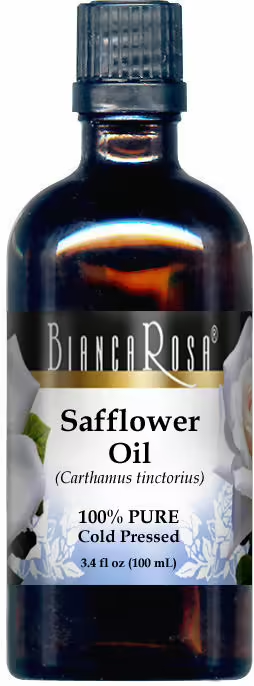

The safflower plant, which is related to the thistle, is thought to be native of Egypt and the Far East. The highest quality oil is warm-pressed from the seeds; it has a deep, golden-ye...
* Please Note: Traditional Use information is provided as a courtesy only. Although we have done our best to review the validity of these uses and we continue to revise this information as new data emerges, the traditional uses indicated on this page for this product may be wrong. This information is based on Traditional and Folklore Medicine which uses natural materials to support health. This information has not been evaluated or approved by the FDA and is not necessarily based on scientific evidence from any source. These statements have not been evaluated by the Food and Drug Administration (FDA). These products are intended to support general well being and are not intended to treat, diagnose, mitigate, prevent, or cure any condition or disease. If conditions persist, please seek advice from your medical doctor.
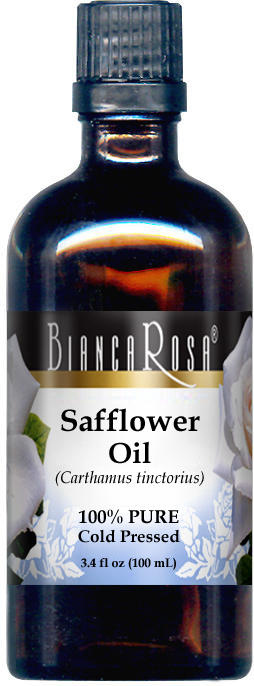
The safflower plant, which is related to the thistle, is thought to be native of Egypt and the Far East. The highest quality oil is warm-pressed from the seeds; it has a deep, golden-yellow hue and a faint, nutty odour. Unrefined safflower oil is rich in essential fatty acids and contains useful levels of vitamin E. It is also a natural sun filter, screening out, on average, up to 20 per cent of the sun's rays. However, the unrefined oil is especially vulnerable to oxidation and should be stored in the fridge.
Percentage in Blends: Can be used as a base oil, 100 percent.
General Herb Information
Safflower Carthamus tinctorius L.
Family: Asteraceae.
Other Names: Saffron thistle; hong hua (Chinese); carthame (French); Färberdistel, Saflor (German); cartamo (Italian); cártamo (Spanish).
Description: Safflower is an erect annual herb with toothed, prickly leaves and attractive yellow flower heads surrounded by bristly bracts. The fruits are small, white, one-seeded nuts (achenes).
Origin: Unknown. The earliest archaeological records are from Mesopotamia. The plant is cultivated for medicinal use mainly in China, while production of seed oil is centred in India, the USA, Mexico and Ethiopia.
Parts Used: Flowers (Cartharmi flos), also the seeds and seed oil (Carthami oleum).
Uses and Properties: Flowers are important in Chinese medicine for treating gynaecological ailments, inflammation, heart disorders, and fever. Also used to relieve lower abdominal pain and to clean and treat wounds, scars, swellings, and sprains. The unpurified oil is slightly purgative; used against Crohn`s disease.
Active Ingredients: The yellow pigments in the flowers are glucosylated dichalcones (such as carthamin, safflor yellow B, safflomin C, hydroxysafflor yellow A and tinctormine). Also present are numerous flavonoids (mainly glycosides of quercetin and luteolin), alpha-tocopherol, triterpene alcohols (mainly heianol) and polysaccharides.
Pharmacological Effects: Both the flowers and the oil have cholesterol lowering effects, while the polysaccharides are reported to act as immune stimulants. Uterotonic activity has been demonstrated in animal studies. Tinctormine has strong calcium antagonistic action, the flavonoids show antioxidant effects, alpha-tocopherol has vitamin E activity and the triterpene alcohols are anti-inflammatory.
Notes: Flowers are a source of yellow or red dye and are used as an adulterant of saffron and to colour butter, liqueurs, confectionery and cosmetics. The oil has the highest linoleic acid content of any known seed oil and is used as a source of this acid in the health food industry.
Status: Traditional medicine; Pharm.
User Group Forum
Share your questions and information with the ZooScape community!
Bridgett - June 17, 2008, 11:34
#10001733
Is it true that Safflower oil can be used in conjunction with other essential oils for split ends?
Anonymous - April 25, 2006, 17:14
#10000196
What is the difference between cold pressed, or the safflower oil I just bought in the grocery store. I am using the product for weight loss.
Thank You
ZooScape Moderator - April 26, 2006, 09:59
#10001294
First, let's begin by saying that this Safflower Oil is not to be taken internally. This is a carrier oil that is used in aromatherapy and is blended with essential oils to create various scents. It is only for external use.
Oils are extracted mechanically and are either cold pressed or hot pressed (with or without a solvent). Using hydraulic presses at a maximum temperature of 172F performs COLD PRESSING. Cold-pressed oils are not subject to further treatment (only filtering).
Directions
Bianca Rosa® natural carrier oils provide the perfect medium in which to dilute potent essential oils and "carry" them onto the skin and into the body. These deep-nourishing oils provide even distribution and absorption with light and non-sticky lubrication. Depending on the potency of the essential oil being diluted, generally, adding 1-3 drops of essential oil to every 5 mL (1 tsp.) of carrier oil is sufficient for most massage or skin care needs. Massage gently into the skin with a circular motion. Apply as needed or as directed.
Cautions
FOR TOPICAL USE ONLY. NOT TO BE TAKEN INTERNALLY.
Should skin sensitivity occur discontinue use. Store in a cool dry place. Keep out of reach of children.
These statements have not been evaluated by the Food and Drug Administration (FDA). Products are intended to support general well being and are not intended to treat, diagnose, mitigate, prevent, or cure any condition or disease. If conditions persist, please seek advice from your medical doctor. The essence of the current American rule on Traditional Uses is, as stated by FTC, "Claims based on historical or traditional use should be substantiated by confirming scientific evidence, or should be presented in such a way that consumers understand that the sole basis for the claim is a history of use of the product for a particular purpose."