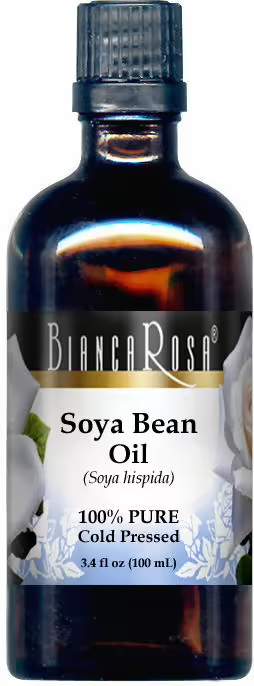

It is extremely difficult to obtain warm-pressed soya oil. The beans contain very little oil, so producers favour solvent extraction because it gives a higher yield. If you can find an unrefined soy...
* Please Note: Traditional Use information is provided as a courtesy only. Although we have done our best to review the validity of these uses and we continue to revise this information as new data emerges, the traditional uses indicated on this page for this product may be wrong. This information is based on Traditional and Folklore Medicine which uses natural materials to support health. This information has not been evaluated or approved by the FDA and is not necessarily based on scientific evidence from any source. These statements have not been evaluated by the Food and Drug Administration (FDA). These products are intended to support general well being and are not intended to treat, diagnose, mitigate, prevent, or cure any condition or disease. If conditions persist, please seek advice from your medical doctor.
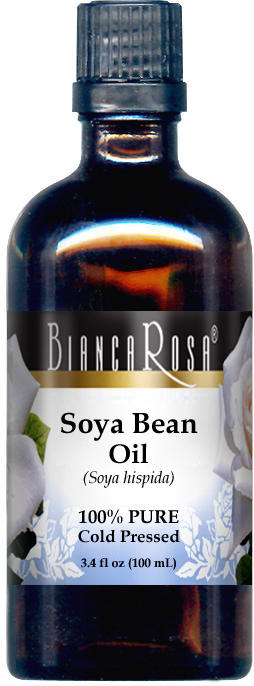
It is extremely difficult to obtain warm-pressed soya oil. The beans contain very little oil, so producers favour solvent extraction because it gives a higher yield. If you can find an unrefined soya oil, it will contain appreciable quantities of vitamin E and lecithin.
Percentage in Blends: Can be used as a base oil, 100 percent.
General Herb Information *Note: Bianca Rosa® Soya Bean Oil is not to be taken internally.
Soy Bean Glycine max (L.) Merr.
Family: Fabaceae.
Other Names: Fève de soja (French); Sojabohne (German); soia (Italian).
Description: An erect, hairy annual herb with trifoliate leaves and small flowers borne close to the stem. The fruit is a pod containing up to four seeds of vaariable colour and size, depending on the cultivar.
Origin: Central and eastern Asia; thought to be a cultigen derived from G. soya as the wild ancestor; cultivated in China since ancient times and now a major world crop.
Parts Used: Seeds (Sojae semen), lecithin and oil (Lecithinum ex soja; Sojae oleum).
Uses and Properties: Soybeans may have important dietary value in reducing blood lipid (especially cholesterol) levels, enhancing liver physiology, reducing the symptoms of menopause and the incidence of prostatic and breast cancer. These assumptions are mainly based on comparisons of East Asian people (eating soy as a staple diet) with people from other parts of the world. In Germany, soy lecithin is recommended for the treatment of hypercholesterolemia and other disturbances in the lipid metabolism, as well as in cases of appetite loss, chronic liver disease, including chronic hepatitis. The use of soy isoflavonoids as phytoestrogens in hormone replacement therapy is increasing but somewhat controversial.
Active Ingredients: Soybean phospholipids (so-called essential phospholipids, mainly phosphatidylcholine; 2%), soy proteins (40%) and protease inhibitors, together with isoflavonoids (such as genistein, daidzein. and corresponding glycosides) and triterpene saponins (various soyasaponins) are the main compounds.
Pharmacological Effects: Phospholipids and soy proteins appear to reduce triglyceride and cholesterol levels. Isoflavones weakly bind to oestrogen receptors and can thus modulate oestrogen-regulated genes, especially during menopause (when endogenous oestrogen levels are reduced). Genistein specifically inhibits a tyrosine kinase, that plays a role in cell division (often enhanced in rumour cells). Protease inhibitors could also contribute to anti-tumour activities. Soyasaponins appear to be anti-thrombotic and liver-protectant.
Status: Pharm.; Comm. E+.
User Group Forum
Share your questions and information with the ZooScape community!
Be the first to post!
Directions
Bianca Rosa® natural carrier oils provide the perfect medium in which to dilute potent essential oils and "carry" them onto the skin and into the body. These deep-nourishing oils provide even distribution and absorption with light and non-sticky lubrication. Depending on the potency of the essential oil being diluted, generally, adding 1-3 drops of essential oil to every 5 mL (1 tsp.) of carrier oil is sufficient for most massage or skin care needs. Massage gently into the skin with a circular motion. Apply as needed or as directed.
Cautions
FOR TOPICAL USE ONLY. NOT TO BE TAKEN INTERNALLY.
Should skin sensitivity occur discontinue use. Store in a cool dry place. Keep out of reach of children. May cause some sensitization.
Soya oil can be a sensitiser in highly allergic individuals.
These statements have not been evaluated by the Food and Drug Administration (FDA). Products are intended to support general well being and are not intended to treat, diagnose, mitigate, prevent, or cure any condition or disease. If conditions persist, please seek advice from your medical doctor. The essence of the current American rule on Traditional Uses is, as stated by FTC, "Claims based on historical or traditional use should be substantiated by confirming scientific evidence, or should be presented in such a way that consumers understand that the sole basis for the claim is a history of use of the product for a particular purpose."