
* Please Note: Traditional Use information is provided as a courtesy only. Although we have done our best to review the validity of these uses and we continue to revise this information as new data emerges, the traditional uses indicated on this page for this product may be wrong. This information is based on Traditional and Folklore Medicine which uses natural materials to support health. This information has not been evaluated or approved by the FDA and is not necessarily based on scientific evidence from any source. These statements have not been evaluated by the Food and Drug Administration (FDA). These products are intended to support general well being and are not intended to treat, diagnose, mitigate, prevent, or cure any condition or disease. If conditions persist, please seek advice from your medical doctor.
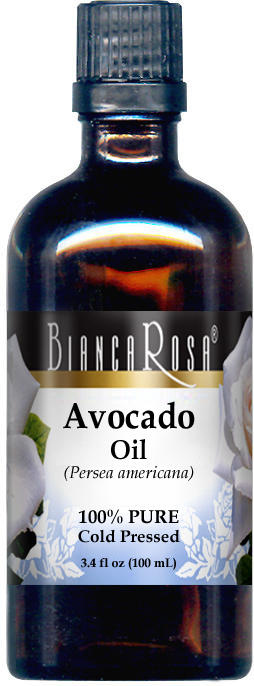
Avocado Persea americana L. (= P. gratissima Gaertn.).
Family: Lauraceae.
Other Names: Avocatier (French); Avocado (German); avocado (Italian); ahuacate (Spanish).
Description: An evergreen tree (up to 40 m) with large, simple, bright green leaves that are characteristically paler green below. Small, yellowish flowers are borne near the branch tips and they are followed by large, usually pear-shaped, green or purple fruits. The fruit has a thin leathery skin with a thick layer of greenish yellow, butter-textured flesh around a very large seed.
Origin: Central America; probably cultivated since ancient times for its delicious and nutritious fruits. Commercial production is centred mainly in California, Mexico, Chile, Israel, Australia and South Africa.
Parts Used: Oil, extracted from the fruit flesh (Avocado oleum); also the leaves (Perseae folium).
Therapeutic Category: Emollient, cosmetic.
Uses and Properties: Avocado oil has become popular as a natural oil used as a carrier and base for aromatherapy oils and cosmetic products. It is a popular ingredient of "natural" or "organic" skin care products such as ointments, skin creams, soaps and shampoos. Leaves have been used in Mexico to treat menstrual disorders and for contraception.
Preparation and Dosage: The oil is used as carrier in aromatherapy or in various combinations with other cosmetic ingredients.
Active Ingredients: Unsaponifiable matter (non-glyceride constituents) occur in avocado oil up to 1%. Branched hydrocarbons, phytosterols and triterpene alcohols, such as cycloartenol, methylcycloartenol, make up the bulk of the 1%. The oil itself is variable in composition but contains oleic acid as main coststituent, together with substantial quantities of palmitic acid, palmitoleic acid, linoleic acid and small amounts of gamma-linolenic acid. Leaves produce an essential oil (with estragol, caryophyllen, eugenol and monoterpenes).
Pharmacological Effects: The unsaponifiable fraction of avocado pear oil, in combination with that of soybean oil, has been tested for use against ailments of the mouth (in stomatology) and as treatment for gum diseases (periodontitis). It is considered to be of potential value in the supportive treatment of arthritis pain.
Notes: Another example of a natural cosmetic oil it argan oil, obtained from the fruits of a thorny Moroccan tree, Argania spinosa (Saporaceae).
Status: Traditional medicine; Pharm.
User Group Forum
Share your questions and information with the ZooScape community!
Be the first to post!
Directions
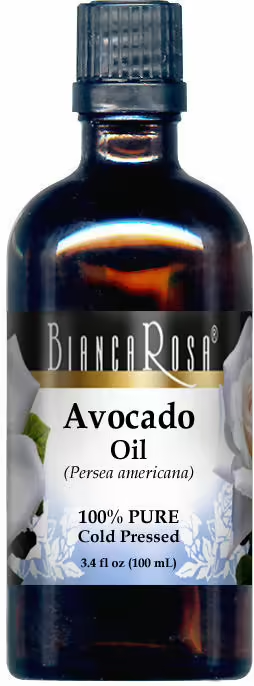
Bianca Rosa® natural carrier oils provide the perfect medium in which to dilute potent essential oils and "carry" them onto the skin and into the body. These deep-nourishing oils provide even distribution and absorption with light and non-sticky lubrication. Depending on the potency of the essential oil being diluted, generally, adding 1-3 drops of essential oil to every 5 mL (1 tsp.) of carrier oil is sufficient for most massage or skin care needs. Massage gently into the skin with a circular motion. Apply as needed or as directed.
Cautions
FOR TOPICAL USE ONLY. NOT TO BE TAKEN INTERNALLY.
Should skin sensitivity occur discontinue use. Store in a cool dry place. Keep out of reach of children.
These statements have not been evaluated by the Food and Drug Administration (FDA). Products are intended to support general well being and are not intended to treat, diagnose, mitigate, prevent, or cure any condition or disease. If conditions persist, please seek advice from your medical doctor. The essence of the current American rule on Traditional Uses is, as stated by FTC, "Claims based on historical or traditional use should be substantiated by confirming scientific evidence, or should be presented in such a way that consumers understand that the sole basis for the claim is a history of use of the product for a particular purpose."