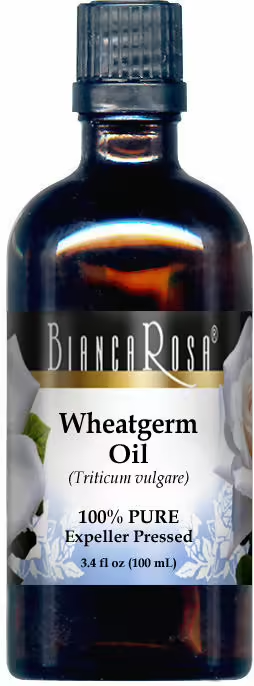

The oil is either warm-pressed or solvent extracted from the 'germ' of the wheat. It is thick and sticky with an orangy-brown hue and a strong, earthy odour which is difficult to m...
* Please Note: Traditional Use information is provided as a courtesy only. Although we have done our best to review the validity of these uses and we continue to revise this information as new data emerges, the traditional uses indicated on this page for this product may be wrong. This information is based on Traditional and Folklore Medicine which uses natural materials to support health. This information has not been evaluated or approved by the FDA and is not necessarily based on scientific evidence from any source. These statements have not been evaluated by the Food and Drug Administration (FDA). These products are intended to support general well being and are not intended to treat, diagnose, mitigate, prevent, or cure any condition or disease. If conditions persist, please seek advice from your medical doctor.
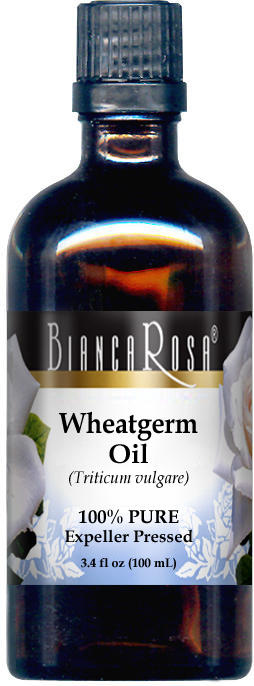
The oil is either warm-pressed or solvent extracted from the 'germ' of the wheat. It is thick and sticky with an orangy-brown hue and a strong, earthy odour which is difficult to mask. However, the oil is extremely rich in vitamin E. Taken internally, wheatgerm oil is said to help eczema, prevent the development of varicose veins and to remove cholesterol deposits from the arteries. Applied topically, the oil is believed to penetrate deep into the skin, from where it acts to repair some of the damage caused by excessive exposure to sunlight. For this reason, wheatgerm oil is popular in beauty care.
Percentage in Blends: Wheatgerm oil is far too sticky to use on its own. Most aromatherapists add up to 15 per cent of wheatgerm oil to lighter base oils, such as almond or grapeseed. The oil is also thought to extend the shelf-life of blends because of its so-called antioxidant properties. However, there are grave doubts about the ability of wheatgerm oil to prolong the shelf-life of blends.
Wheat, Common Triticum vulgare L.
Medicinal Usage
Wheat was used for inflammations, swellings, eczema, ringworm, painful joints, wounds and ulcers. Gerard said "the fine flour mixed with the yolk of an egg, honey, and a little saffron, doth draw and heal boils and such like sores, in children and in old people, very well and quickly." Pliny mentioned that a man seized with the pains of gout buried himself in wheat up to his knees, and "he was relived of the pain, and the water in his feet dried up in a wonderful way."
Culinary Usage
Grains of wheat, ground into flour, were used in cooking, especially for bread, cakes and pastries. The wheat germ, extracted before milling, was also a valued food.
Miscellaneous
Wheat, one of the oldest and most important of cereal crops, has been cultivated in Britain since prehistoric times. Archaeological research has established that a form of the grass grew in the Holy Land some 9,000 years ago. Grains of wheat have been discovered in ancient Egyptian tombs. In medieval times a corn dolly, plaited from the straw of the last sheaf of wheat to be harvested, was stored over winter and ploughed into the ground the following spring. It was believed to contain the Harvest Spirit, whose survival was essential to ensure the success of the crop that followed. The reed straw was also used for thatching.
User Group Forum
Share your questions and information with the ZooScape community!
Be the first to post!
Directions
Bianca Rosa® natural carrier oils provide the perfect medium in which to dilute potent essential oils and "carry" them onto the skin and into the body. These deep-nourishing oils provide even distribution and absorption with light and non-sticky lubrication. Depending on the potency of the essential oil being diluted, generally, adding 1-3 drops of essential oil to every 5 mL (1 tsp.) of carrier oil is sufficient for most massage or skin care needs. Massage gently into the skin with a circular motion. Apply as needed or as directed.
Cautions
FOR TOPICAL USE ONLY. NOT TO BE TAKEN INTERNALLY.
Should skin sensitivity occur discontinue use. Store in a cool dry place. Keep out of reach of children.
These statements have not been evaluated by the Food and Drug Administration (FDA). Products are intended to support general well being and are not intended to treat, diagnose, mitigate, prevent, or cure any condition or disease. If conditions persist, please seek advice from your medical doctor. The essence of the current American rule on Traditional Uses is, as stated by FTC, "Claims based on historical or traditional use should be substantiated by confirming scientific evidence, or should be presented in such a way that consumers understand that the sole basis for the claim is a history of use of the product for a particular purpose."