
Evening Primrose Oil - 100% Pure, Cold Pressed,Bianca Rosa,buy,purchase,Oenothera fiennis,fever plant,common primro
Books
Sign In | View Cart Cart | Wish List | Help
ToysHealthPersonalAdultBaby
Home & Garden
Checkout Now »
Cart Cart Cart
0 Items
Cart
100% Safe and Private!
Search     for:    
Phone - 1-800-760-8783
Books
You are here: Home > Health > Oils and Essences > Carrier Oils > Evening Primrose OilHealth

Oils and Essences
Carrier Oils
Apricot Oil
Avocado Oil
Borage Oil
Camellia Seed
Canola Oil
Carrot Oil
Castor Oil
Cherry Kernel
Coconut Oil
Cotton Seed
Flax Seed Oil
Grape Seed Oil
Hazelnut Oil
Hemp Seed Oil
Holly Oil
Jojoba Oil
Linseed Oil
Macadamia Oil
Meadowfoam Oil
Olive Oil
Palm Oil
Passionfruit
Pecan Oil
Pumpkin Oil
Rice Bran Oil
Rosehip Oil
Safflower Oil
Sea Buckthorn
Sesame Oil
Soya Bean Oil
Sunflower Oil
Sweet Almond
Walnut Oil
Wheatgerm Oil
Evening Primrose Oil


Questions?

Telephone Us Now!

1-800-760-8783
1-905-494-1785

Email us now!
 

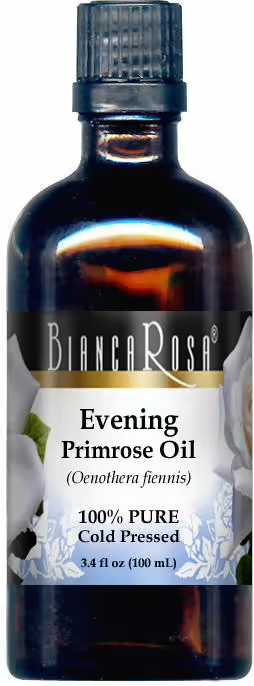
Evening Primrose Oil - 100% Pure, Cold Pressed
by Bianca Rosa
3.4 fl oz

Evening Primrose Oil - 100% Pure, Cold Pressed

Enlarge Photo
 
Evening Primrose Oil

(Oenothera biennis L.)

Evening primrose oil has an exceptionally fine texture and a faint musty odour. It is captured from the minute seeds of the bright yellow flowers which bloom only at night. The o... *

It works !
"I gave this to my friend who's baby suffers from atopic eczema. She said it really works for her baby. She applied this to her baby's itchy and scaly skin and she said she could see the effect."  -- Kory


More Info below.
 
  Our Price: $12.71 US
  
Click button to Buy.  
  In Stock - Ships Right Now!Add To Wish ListAdd To Wish List  

Specifications

ZIN Product Number: 428133
Size: 3.40 fl oz
Weight: 0.57 lbs (0.26 KG)
Size (inches): 1.73" X 1.73" X 4.53"
Size (cm): 4.4 cm X 4.4 cm X 11.5 cm

Manufacturer:
Bianca Rosa

Ingredients: Evening Primrose Oil

* Please Note: Traditional Use information is provided as a courtesy only. Although we have done our best to review the validity of these uses and we continue to revise this information as new data emerges, the traditional uses indicated on this page for this product may be wrong. This information is based on Traditional and Folklore Medicine which uses natural materials to support health. This information has not been evaluated or approved by the FDA and is not necessarily based on scientific evidence from any source. These statements have not been evaluated by the Food and Drug Administration (FDA). These products are intended to support general well being and are not intended to treat, diagnose, mitigate, prevent, or cure any condition or disease. If conditions persist, please seek advice from your medical doctor.
Add To Wish ListAdd To Wish List  


Description

Evening Primrose Oil

(Oenothera biennis L.)

Evening primrose oil has an exceptionally fine texture and a faint musty odour. It is captured from the minute seeds of the bright yellow flowers which bloom only at night. The oil is especially vulnerable to heat, so most producers extract the substance by employing the petroleum-derived solvent, hexane. The resulting oil is golden yellow, and almost identical in chemical composition to that which is found within the seed. It is possible to obtain warm-pressed evening primrose oil (labelled 'cold-pressed'). Unfortunately, the warm-pressed oil must undergo a process of refining in order to remove the dust-like seed husks which saturate the product. Having been subjected to a certain amount of heat - albeit naturally generated - as well as the refining process itself, the end product is a pale shade of yellow and contains fewer nutrients. In this instance, it is difficult not to concede that solvent extracted evening primrose oil is superior to that which is labelled 'cold-pressed'.

Evening primrose oil contains vitamins, minerals and essential fatty acids, including the important gamma linolenic acid. The oil is used mainly as a nutritional supplement to help conditions such as eczema, multiple sclerosis, heart disease, arthritis, PMS (pre-menstrual syndrome) and benign breast disease. When applied externally, the oil is a superb moisturiser, hence its popularity in beauty care.

Much more remarkable, evening primrose oil rubbed into the skin seems to reduce hyperactivity in babies and young children. Anecdotal evidence suggests that the nutrients of evening primrose oil reach the bloodstream via skin absorption.

Percentage in Blends: For body massage, add the contents of two x 500 mg capsules of evening primrose oil to 50 ml (or less) of a relatively inexpensive base oil, such as sunflower seed. (Pierce the evening primrose oil capsule with a pin and squeeze out the oil.)

General Herb Information

English Common Names

(Yellow) evening primrose. Archaic names: tree primrose, scurvish, scabbish (scabish), king's cure-all, nightwillow herb, sundrops, tree primrose, fever plant.

The name evening-primrose is optionally hyphenated. Evening primrose isn't a "primrose," a name best applied to the genus Primula. The "evening" in the name relates to the fact that the flowers of many of the 125 species of Oenothera open in the evening and release a scent that attracts moths for pollination.

French Common Names

Onagre bisannuelle (commune).

Morphology

Oenothera biennis is a biennial (as the name suggests) or short-lived perennial herb producing strong fleshy roots and a basal rosette of lanceolate leaves in the first year. In the second year the stem grows to 1-2 m tall and develops a spicate inflorescence of 4-parted, yellow, tubular flowers. The fruit is a capsule containing many seeds which mature in the fall. The seeds are very small (ca. 0.5 g/l000), but a single plant can easily produce 150,000. The pollen of many, if not all species of Oenothera, is unusual in having protruding apertures and viscin threads.

Classification and Geography

Evening primrose, a native of North America, is found in all provinces of Canada, but is more frequent in the east than the west. The species extends south to Florida and Mexico.

Many texts recognize var. canescens T. & G., with dense grayish pubescence, as the predominant plant of western North America, while the eastern plants are referable to var. biennis. The classification of the transcontinental O. biennis and related Evening Primrose species of both North America and Eurasia is, however, very complex. Cytogenetic races of evening primrose are sometimes segregated as distinct species, although these are usually difficult to distinguish morphologically.

Oenothera biennis is a complete translocation complex-heterozygote, with two sets (the "complexes") of seven chromosomes maintained by a system of balanced lethal genes. This type of inheritance is known in a few other genera, but was first described in O. biennis, and is the classical example of the phenomenon discussed in evolution and genetics courses. At meiosis, translocations link the chromosomes into a ring of 14, but zig-zag (alternate) separation of the chromosomes generates the original parental sets. Lethal factors kill the pollen carrying one of the sets (so that there is 50% pollen fertility), and ovule lethal factors limit survival to the set of chromosomes complementary to that in the pollen. Self-pollination generates offspring with the two chromosome complements found originally in the maternal plant. The permanent hybrid vigor resulting from the combination of two quite different genomes is thought to explain the success of evening primrose as a colonizing species.

While it is clear that O. biennis is the chief Oenothera species that has been grown as a medicinal oilseed, related species have also been cultivated, often unknowingly. Other species from which cultivars have been derived include O. glazioviana Micheli ("O. lamarckiana" of many authors) and O. parviflora Micheli.

Ecology

Evening primrose is a frequent weed of roadsides, waste places, and abandoned land, often found in light sandy and gravelly soils. It commonly occurs in association with early successional, biennial and perennial weeds.

Medicinal Uses

Evening primrose extracts were used medicinally by both Indians and early settlers. In Europe during the early 1600s it was called "King's Cure-all." An infusion of the whole plant was thought to counter asthmatic cough, gastro-intestinal disorders, and whooping cough, and to reduce pain. Poultices were used to treat bruises and wounds.

Evening primrose has attracted great interest for its seed oil, used medicinally as a nutritional supplement. The health value of the seed oil resides in an unusual polyunsaturated fatty acid, y-linolenic acid (gamma-linolenic acid) or simply GLA. The seeds contain 17-25% oil, of which only 7-10% is GLA, although climate and maturity affect oil content and qualitative composition, as well as overall yield. GLA is one of the so-called essential fatty acids needed by humans for maintenance of cell functions. It is a precursor in the biosynthesis of prostaglandins, especially prostaglandin El, a hormone-like substance that has been clinically shown to regulate metabolic functions in mammals; it affects cholesterol levels, dilates blood vessels, reduces inflammation, and has additional effects. GLA is thought to be important for development of brain tissue and other tissue growth, and nature seems to provide for human infants with high levels of GLA in human milk. GLA is a normal conversion product of linoleic acid, a major constituent of most vegetable oils, so that it would appear that humans should not experience a shortage. Nevertheless, some people, perhaps 10-20% of the population, evidently do not have adequate levels, even when receiving large amount of linoleic acid. The deficiency seems due to lack of an enzyme that metabolizes GLA from linolenic acid, so that there is a deficiency of GLA in the blood. Useful for treating atopic eczema, GLA has therapeutic promise for premenstrual syndrome, diabetes, multiple sclerosis, alcoholism, inflammation, heart disease and stroke. Rubbing GLA into the skin is thought to be an alternative route of assimilation, and so cosmetic preparations sometimes incorporate GLA. Pharmaceutical and food companies are developing GLA-containing supplements and specialty foods for infants, the elderly, and people with health problems.

Chemistry

Gamma-linolenic acid, the constituent of chief medicinal interest, is discussed above.

Non-medicinal Uses

There are ornamental forms of Oenothera biennis with attractive habit and flowers. There are also forms with fleshy edible roots, used as a vegetable, which were more commonly grown in the nineteenth century than today. Evening primrose leaves, shoots, roots, and seed pods were consumed by American Indians as food.

Agricultural and Commercial Aspects

The most significant current economic value of the species lies in its use as a diversification crop. Although GLA has been obtained by fermentation of some yeasts and other fungi, and from currants (Ribes species), the chief commercial sources are evening primrose and borage (Borago officinalis L.). Companies have engaged in a boastful debate about the comparative efficacy of GLA in their preparations made from evening primrose on the one hand, and from borage on the other. Whether borage or evening primrose is more competitive for GLA production depends on climatic and edaphic factors at a particular location. In Canada, both species are grown. Borage has a higher GLA content, but non-shattering cultivars are not grown in Canada, so that harvest is difficult. Borage is much more suitable for the Canadian prairies, where available cultivars of evening primrose do not overwinter reliably. However it isn't essential to grow evening primrose as a biennial: in Eastern Canada it is often started in greenhouses in mid-winter and transplanted to the field where it is grown as an annual.

As a cultivated plant, evening primrose is tolerant of a variety of soil types and a range of pH, but soils that are prone to crusting after rains and waterlogged soils should be avoided. If planted at too high a density (150 plants m2) the plants may not bolt.

Evening primrose crops are raised in temperate areas of northern and eastern Europe, North America, and Australasla. US production is centered in North and South Carolina, Texas, and Oregon. Canadian production is centered in Nova Scotia and Ontario. Experimental production in Manitoba has been disappointing. Annual world production of seed has increased at least 20 fold in the last 20 years, and is currently about 4,000 tonnes. Combined US, and Canadian annual production is less than 200 tormes. In good market years, several hundred ha of evening primrose may be grown in Canada.

Wild evening primrose plants shed their seeds when a pod matures, and since the pods don't mature simultaneously, harvest of seeds is difficult. Nevertheless, seed is gathered from wild plants in northeast China. Most modern evening primrose cultivars have non-shedding pods, which has simplified harvest and reduced seed loss. Crop yields of over 2 tonneslha have been recorded in Nova Scotia, although much lower yields are frequent. In Ontario, depending on the rather volatile market and variable production, a hectare may result in a gross financial return of $ 1,000-2,000.

The future of evening primrose as a pharmacological crop in Canada is uncertain because of competition from other countries and the unreliability of the present market. Hemp (Cannabis sativa L.) is attracting considerable interest as a new crop in Canada, to be grown not only for fiber but also for its high-GLA seed oil. Still another potential source of competition is the possibility that genetic engineers will splice the capacity to produce GLA into crops such as canola (Brassica species). Certainly the demand for GLA will continue to grow, and at least from time to time it may be anticipated that evening primrose crops will be grown in Canada on a contracted basis. With respect to climate and native gennplasm, Canada is in a good position to develop its share of the evening primrose market.

Myths, Legends, Tales, Folklore, and Interesting Facts
  • Some evening primrose seeds have been shown to live to 80 years in the soil.
  • Hugo de Vries (1848-1935) was a world-famous student of evolution who, at the beginning of the 20th century, theorized that new species arise by spontaneous changes in individuals called mutations (Charles Darwin had earlier learned that such changes (called "sports" at the time) occur, but did not appreciate their importance for the mechanism of evolution). Unfortunately for de Vries, he chose evening primrose to demonstrate his theory. Later, scientists learned that the odd genetic system of evening primrose was responsible for the generation of altered individuals that de Vries was labelling as mutations and that this system did not occur in many other plants. As a result, his theory was discredited, although de Vries did contribute substantially to evolutionary theory.


User Group Forum
Share your questions and information with the ZooScape community!
Anonymous - May 17, 2006, 10:18#10000518
Questionwhat are the side effects useing evening primrose
ZooScape Moderator - May 17, 2006, 12:15#10001387
Serious side effects from taking evening primrose are extremely rare. If you experience any symptoms of an allergic reaction such as hives, swelling, seizures, or constricted breathing, you should discontinue use and consult a medical professional immediately. Other more commonly reported side effects include indigestion, nausea, softening of the stools, and headaches.

The following medications may interact with evening primrose: any medicine to treat seizures or epilepsy, chlorpromazine (Thorazine), fluphenazine (Prolixin, Permitil), mesoridazine (Serentil), perphenazine (Trilafon), prochlorperazine (Compazine), promethazine (Phenergan, Promethegan), thioridazine (Mellaril), trifluoperazine (Stelazine), or triflupromazine. There may be additional drugs that lead to adverse reactions with evening primrose, so if you are taking any of these medications, consult a healthcare practitioner for the approval to take evening primrose or for any necessary dosage control and adjustment.


Directions

Bianca Rosa® natural carrier oils provide the perfect medium in which to dilute potent essential oils and "carry" them onto the skin and into the body. These deep-nourishing oils provide even distribution and absorption with light and non-sticky lubrication. Depending on the potency of the essential oil being diluted, generally, adding 1-3 drops of essential oil to every 5 mL (1 tsp.) of carrier oil is sufficient for most massage or skin care needs. Massage gently into the skin with a circular motion. Apply as needed or as directed.
 

Cautions

FOR TOPICAL USE ONLY. NOT TO BE TAKEN INTERNALLY.

Should skin sensitivity occur discontinue use. Store in a cool dry place. Keep out of reach of children.

Toxicity

Side effects of consumption of GLA-fortified foods and supplements have been documented, so that use should be guided by doctors and pharmacists.


Share Your Review!

Click here to share a review!

Number of Reviews: 2    Average Rating: 5.0

It works !  Evening Primrose Oil - 100% Pure, Cold Pressed

I gave this to my friend who's baby suffers from atopic eczema. She said it really works for her baby. She applied this to her baby's itchy and scaly skin and she said she could see the effect.

-- Kory

Also Recommended: My friend said Primrose ointment wasn't as effective as this primrose oil.


Great Service!  Evening Primrose Oil - 100% Pure, Cold Pressed

-- Anonymous


  Our Price: $12.71 US
  
Click button to Buy.  
  In Stock - Ships Right Now!Add To Wish ListAdd To Wish List  


   People Like You Also Bought...

You may also be interested in:
 
Sesame Oil - 100% Pure, Cold Pressed
 
Sesame Oil - 100% Pure, Cold Pressed
A-Z Browse!
Vitamins (A-Z)
Herbs (A-Z)
Homeopathy (A-Z)
Essential Oils (A-Z)
Health Interests (A-H)
Health Interests (I-Z)

Share A Review!
Number of Reviews
for this Product:
2
Average Rating
for this Product:
5 Stars
AwfulWonderful  

1

2

3

4

5

Happy Customers
Quinine Bark (Red Cinchona) - 325 mg
Quinine Bark
TerraVitaI'm really happy with my purchase. Both my fiancee, and I suffer from leg cramps, which even added p  [continues ...]

-- Beth

Quinine Bark (Red Cinchona) - 325 mg

 
Quinine Bark (Red Cinchona) - 325 mg
Relieve Leg Cramps
TerraVitaRecently purchased Red Cinchona/Quinine Bark from Zooscape for relief from night leg cramps, looking  [continues ...]

-- 4urhealth

Quinine Bark (Red Cinchona) - 325 mg

Bestsellers!
Evening Primrose Oil - 100% Pure, Cold Pressed

Bianca Rosa

 
Evening Primrose Oil, Cold Pressed (10% GLA) - 500 mg

Swiss Natural Sources

 
Wheat Germ Oil - Expeller Pressed

Now

News!
"The right food can ease PMS symptoms."
June 19, 2006
Jamaica Observer - Kingston,Jamaica
Related to: Evening Primrose Oil
 

Articles
  • "Lose Weight Naturally."

  •  


    Your Special Deal!
    High Cholesterol Complex - Guggulipid Extract and Artichoke Leaf Extract - 450 mg

    TerraVita

    Save $9.99
    Price: $29.98 US


    Make $1 per sale -
    Link to ZooScape.com!


    These statements have not been evaluated by the Food and Drug Administration (FDA). Products are intended to support general well being and are not intended to treat, diagnose, mitigate, prevent, or cure any condition or disease. If conditions persist, please seek advice from your medical doctor. The essence of the current American rule on Traditional Uses is, as stated by FTC, "Claims based on historical or traditional use should be substantiated by confirming scientific evidence, or should be presented in such a way that consumers understand that the sole basis for the claim is a history of use of the product for a particular purpose."

    FTC - Dietary Supplements: An Advertising Guide for Industry


    Sign In  |  Shipping  |  Returns  |  Where to Buy  |  About Us  |  Contact Us  |  1-800-760-8783
    ZooScape.com

    Copyright 1995 - 2008 - ZooScape.com
     
    ZooScape.com