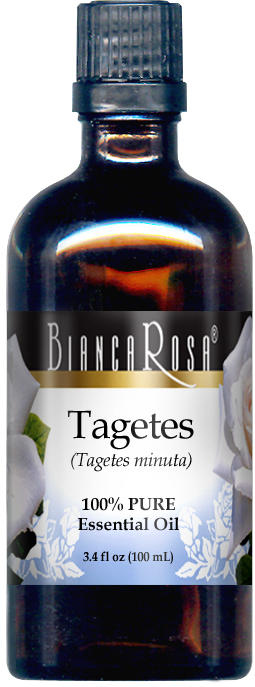
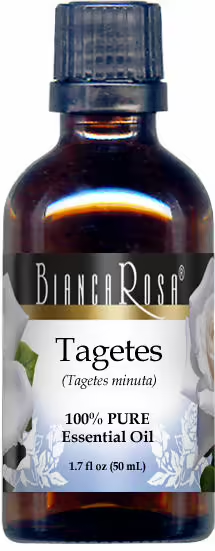

Tagetes is an annual herb up to 60 cm high with soft, oval, pale leaves and bright orange daisy-like flowers. The essential oil is obtained by steam distillation from the fresh flowering herb and also an absolute (and concrete) by solvent extraction ...
* Please Note: Traditional Use information is provided as a courtesy only. Although we have done our best to review the validity of these uses and we continue to revise this information as new data emerges, the traditional uses indicated on this page for this product may be wrong. This information is based on Traditional and Folklore Medicine which uses natural materials to support health. This information has not been evaluated or approved by the FDA and is not necessarily based on scientific evidence from any source. These statements have not been evaluated by the Food and Drug Administration (FDA). These products are intended to support general well being and are not intended to treat, diagnose, mitigate, prevent, or cure any condition or disease. If conditions persist, please seek advice from your medical doctor.
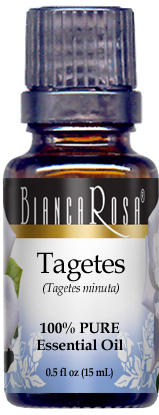
Tagetes is an annual herb up to 60 cm high with soft, oval, pale leaves and bright orange daisy-like flowers. The essential oil is obtained by steam distillation from the fresh flowering herb and also an absolute (and concrete) by solvent extraction from the flowering herb. Tagetes is native to South America and Mexico, but now grows wild in Africa, Europe, Asia, and North America. The oil is produced mainly in South Africa, France, Argentina and Egypt.
Uses - It is used for skin complaints, menstrual irregularities, varicose veins, hemorrhoids, conjunctivitis, and poor eyesight. Tagetes is used in some pharmaceutical products. The absolute and oil are employed to a limited extent in herbaceous and floral perfumes. It is also used for flavoring tobacco and in most major food categories, including alcoholic and soft drinks. In China the flowers are used for whooping cough, colds, colic, mumps, sore eyes and mastitis, and in India the flowering tops are distilled to produce "attar genda" a perfume material.
Blends with - clary sage, lavender, jasmine, bergamot and other citrus oils in very small percentages.
Origin - Africa, Asia, North & South America.
Appearance - A yellow reddish liquid with an unpleasant, rancid odor having a fruity, bitter undertone.
Production - The steam distillation of the fresh flowering herb produces Tagetes oil.
User Group Forum
Share your questions and information with the ZooScape community!
Be the first to post!
Directions
All pure essential oils should be used with care. Do not apply directly into skin. A 2% dilution of essential oils to a base of carrier oil or lotion is recommended for all skincare and massage preparations.
Ingredients
100% Pure Tagetes Essential Oil
Cautions
A natural ingredient named "tagetone" in this oil may possibly be harmful to humans. There are some reported cases of dermatitis with the tagetes species. Use with care and in moderation. Tagetes Oil should NEVER be put directly on the skin. It should always be mixed with another oil. Serious burning can occur from direct concentrated contact.
During pregnancy, use only with advise from a trained aromatherapist. Keep all bottles out of reach of children.
Additional Information
Essential Oils by RedSafari.com are 100% Pure Natural Essences derived from the highest quality fruits, flowers, leaves, spices, herbs and roots. Our essential oil distillers and growers are located around the world, operating ethically, organically and chemical-free.
RedSafari.com Essential Oils Are Not Tested On Animals.
These statements have not been evaluated by the Food and Drug Administration (FDA). Products are intended to support general well being and are not intended to treat, diagnose, mitigate, prevent, or cure any condition or disease. If conditions persist, please seek advice from your medical doctor. The essence of the current American rule on Traditional Uses is, as stated by FTC, "Claims based on historical or traditional use should be substantiated by confirming scientific evidence, or should be presented in such a way that consumers understand that the sole basis for the claim is a history of use of the product for a particular purpose."