
* Please Note: Traditional Use information is provided as a courtesy only. Although we have done our best to review the validity of these uses and we continue to revise this information as new data emerges, the traditional uses indicated on this page for this product may be wrong. This information is based on Traditional and Folklore Medicine which uses natural materials to support health. This information has not been evaluated or approved by the FDA and is not necessarily based on scientific evidence from any source. These statements have not been evaluated by the Food and Drug Administration (FDA). These products are intended to support general well being and are not intended to treat, diagnose, mitigate, prevent, or cure any condition or disease. If conditions persist, please seek advice from your medical doctor.
Tagette, taget, marigold. Many books wrongly cite this oil as 'calendula', confusing it with the pot marigold or Calendula officinalis, which produces too little essential oil to make distillation commercially viable. However, the infused oil of calendula is often used in aromatherapy as a healing base oil.
Description and Distribution
A half-hardy annual of compact and bushy habit. It has dark green deeply cut and divided leaves and an abundance of brownish-orange, daisy-like flowers. The plant is native to Mexico, but extensively cultivated worldwide. Most of the oil is produced in South Africa, South America, Nigeria and France.
Extraction Method
Steam distillation of the fresh flowers and leaves.
Nature of the Oil
A yellowy-orange, slightly viscous liquid. The offbeat aroma is composed of fruity-sweet top notes with a bitter green, murky undertone. It is difficult to offer an objective assessment of the oil's odour effect, except to say that many people find it somewhat disturbing: rather like the resonance of a discordant musical chord.
Athlete's foot, ringworm, absence of menstruation outside pregnancy.
Blends Well With
The oil is extremely difficult to work with, for the penetrating aroma has the curious property of becoming stronger when combined with other essences. Nevertheless, it is just about acceptable when blended with bergamot, orange, lemon or lavender. Tagetes should be used in concentrations of less than 0.5 per cent.
User Group Forum
Share your questions and information with the ZooScape community!
Be the first to post!
Directions
All pure essential oils should be used with care. Do not apply directly into skin. A 2% dilution of essential oils to a base of carrier oil or lotion is recommended for all skincare and massage preparations.
Ingredients
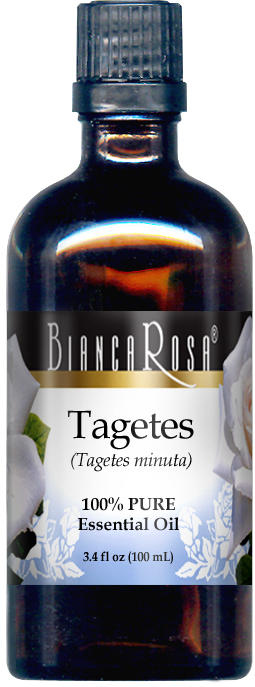
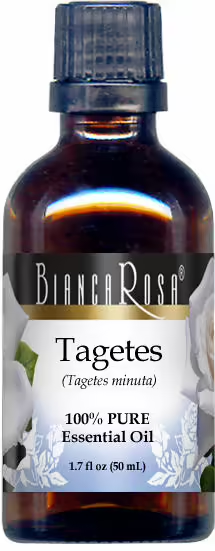
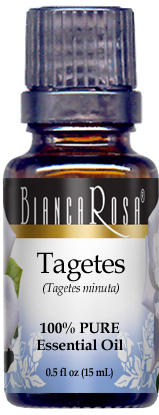
100% Pure Tagetes Essential Oil
Cautions
The oil may cause skin irritation or provoke sensitisation reactions in some people. Highly phototoxic, so avoid skin applications prior to exposure to simulated or natural sunlight. Avoid during pregnancy. Use in very low concentrations.
Additional Information
Essential Oils by RedSafari.com are 100% Pure Natural Essences derived from the highest quality fruits, flowers, leaves, spices, herbs and roots. Our essential oil distillers and growers are located around the world, operating ethically, organically and chemical-free.
RedSafari.com Essential Oils Are Not Tested On Animals.
These statements have not been evaluated by the Food and Drug Administration (FDA). Products are intended to support general well being and are not intended to treat, diagnose, mitigate, prevent, or cure any condition or disease. If conditions persist, please seek advice from your medical doctor. The essence of the current American rule on Traditional Uses is, as stated by FTC, "Claims based on historical or traditional use should be substantiated by confirming scientific evidence, or should be presented in such a way that consumers understand that the sole basis for the claim is a history of use of the product for a particular purpose."