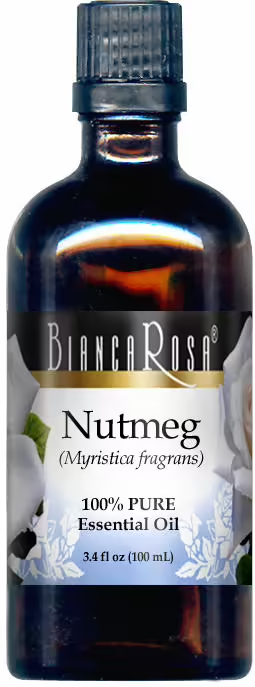

The middle-note scent of nutmeg oil is sweet, musky, and spicy with an odor intensity of about four out of five. Blending companions fo nutmeg oil include florals, woods, and spices. For physical usage, the oil is a beneficial digestive tonic, and it...
* Please Note: Traditional Use information is provided as a courtesy only. Although we have done our best to review the validity of these uses and we continue to revise this information as new data emerges, the traditional uses indicated on this page for this product may be wrong. This information is based on Traditional and Folklore Medicine which uses natural materials to support health. This information has not been evaluated or approved by the FDA and is not necessarily based on scientific evidence from any source. These statements have not been evaluated by the Food and Drug Administration (FDA). These products are intended to support general well being and are not intended to treat, diagnose, mitigate, prevent, or cure any condition or disease. If conditions persist, please seek advice from your medical doctor.
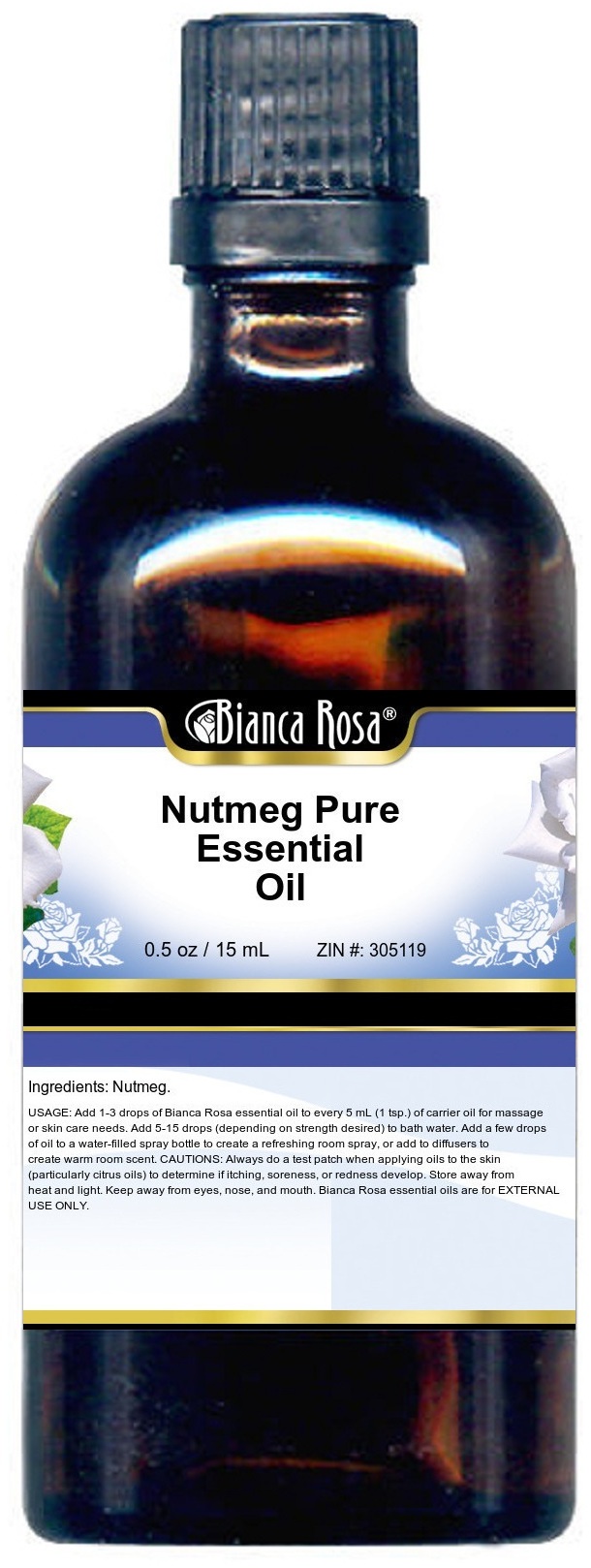
The middle-note scent of nutmeg oil is sweet, musky, and spicy with an odor intensity of about four out of five. Blending companions fo nutmeg oil include florals, woods, and spices. For physical usage, the oil is a beneficial digestive tonic, and its antiseptic actions make it useful for nervous fatigue and impotence. Emotionally, neroli oil is said to boost optimism about money and luck, and overcome confusion and fatigue. Nutmeg is produced by the same tropical tree as mace; the latter is the lacy covering that surrounds the seed. Europeans in the seventeenth century often carried nutmeg and tiny graters to flavor food and drinks.
Nutmeg (Myristica fragrans)
Plant Family
Myristicaceae.
Synonyms
M. officinalis, M. aromata, Nux moschata
Description and Distribution
A tropical evergreen tree growing up to 80 feet (24 m). The tree does not bear fruit until it is about seven or eight years old. The fruits of the nutmeg tree are large and fleshy, like an apricot, splitting open when ripe to reveal the kernel wrapped in its bright red, net-like arils or mace. Nutmeg is native to the Moluccas and islands in the West Indies.
Extraction Method
Steam distillation of the crushed nutmegs. Oil from the islands is re-distilled in France to improve the quality. An oil can also be obtained from the dried aril or mace, but this is rarely available for aromatherapy or perfumery work. More often the arils are removed from the nutmegs and sold for culinary purposes.
Nature of the Oil
A pale yellow liquid. The aroma is very warm, sweet and spicy. Its odour effect is warming and comforting; a reputed aphrodisiac.
Citrus essences, coriander, geranium, neroli, petitgrain, ylang ylang. Nutmeg is highly odoriferous, so use sparingly.
The hard, aromatic fruit kernels of the East Indian nutmeg tree (Myristica fragrans), native to the Molucca or Spice Islands, have been another important trade item of the Orient since antiquity. Because of their resemblance in shape to the human brain, nutmeg kernels were used as a remedy for all ailments of the brain, a cure for failing eyesight, and a general tonic and stimulant. Oil of nutmeg was used as an opiate.
General Information *Note: Bianca Rosa® Nutmeg Pure Essential Oil is for external use only.
Description: Nutmeg is an evergreen tree of up to 20 m in height. Female trees produce a pale brownish yellow, fleshy fruit that splits into two at maturity. Inside is a large, hard seed, surrounded by a peculiar bright red aril that forms a thin, net-like fleshy layer.
Origin: Southeast Asia; indigenous to Amboine Island, one of the Molucca Islands. It was introduced to Mauritius, Malaysia, Sri Lanka, Sumatra and the Caribbean Islands. Most of the commercial product comes from Malaysia, Indonesia and the West Indies (Grenada).
Parts Used: The dried, dehusked seeds (Myristicae semen), the dried seed arils (mace - Myristicae arillus) and essential oil (Myristicae aetheroleum).
Uses and Properties: Nutmeg and/or mace is used to treat complaints of the digestive tract, such as bloating, stomach cramps and diarrhoea, as well as catarrh of respiratory tract. Nutmeg oil is traditionally applied as a counter-irritant for relief of aches and pains.
Preparation and Dosage: Small amounts of the powdered product (0.3 - 1.0 g) is taken three times a day with a little water. Larger doses may cause headache and dizziness. Doses of 5 g or more are dangerous an may cause psychic disturbances, hallucinations, heai palpitations and abortion.
Active Ingredients: Nutmeg and mace contain essential oil (up to 15% of dry weight). The main compounds are sabinen, alpha-pinene and beta-pinene (80%) and myristicine (10%), together with other phenylpropanoids, elemicin, eugenol, isoeugenol, methyleugenol, safrol and others. Seeds contain up to 75% of the fatty oil (known as nutmeg butter) and various lignans and neolignans.
Pharmacological Effects: The drug has pronounced antimicrobial and anti-inflammatory activities (inhibition of prostaglandin formation was demonstrated). The essential oil is known to have a spasmolytic activity and relieves stomach cramps and flatulence. The addictive and hallucinogenic effects are ascribed to myristicin and elemicin that are converted to amphetamine-like compounds.
Status: Traditional medicine; Pharm.
User Group Forum
Share your questions and information with the ZooScape community!
Be the first to post!
Directions
All pure essential oils should be used with care. Do not apply directly into skin. A 2% dilution of essential oils to a base of carrier oil or lotion is recommended for all skincare and massage preparations.
Ingredients
100% Pure Nutmeg Essential Oil
Cautions
Over-use of nutmeg essence (or the whole spice) can cause nausea, hallucinations, over-rapid heartbeat and stupor. The oil may also irritate sensitive skin. Always use in very low concentrations of 0.5 per cent or even less. Avoid during pregnancy.
Overuse of this essential oil can cause headaches, confusion, and hypnotic dreams.
Large quantities of nutmeg and mace can be dangerous (use medicinally only under proper supervision).
Additional Information
Essential Oils by RedSafari.com are 100% Pure Natural Essences derived from the highest quality fruits, flowers, leaves, spices, herbs and roots. Our essential oil distillers and growers are located around the world, operating ethically, organically and chemical-free.
RedSafari.com Essential Oils Are Not Tested On Animals.
These statements have not been evaluated by the Food and Drug Administration (FDA). Products are intended to support general well being and are not intended to treat, diagnose, mitigate, prevent, or cure any condition or disease. If conditions persist, please seek advice from your medical doctor. The essence of the current American rule on Traditional Uses is, as stated by FTC, "Claims based on historical or traditional use should be substantiated by confirming scientific evidence, or should be presented in such a way that consumers understand that the sole basis for the claim is a history of use of the product for a particular purpose."